
Which stone should you choose for your indoor floor?


1. What look are you after?

CONTEMPORARY
Sleek lines, minimalist design
Large format, straight edges, and thin joints: here, stone becomes more understated and architectural. The lines are clean, the surfaces continuous, and the floor naturally complements open volumes and minimalist interiors. The preferred choice for truly contemporary architecture.

MEDITERRANEAN
Sand tones and natural light
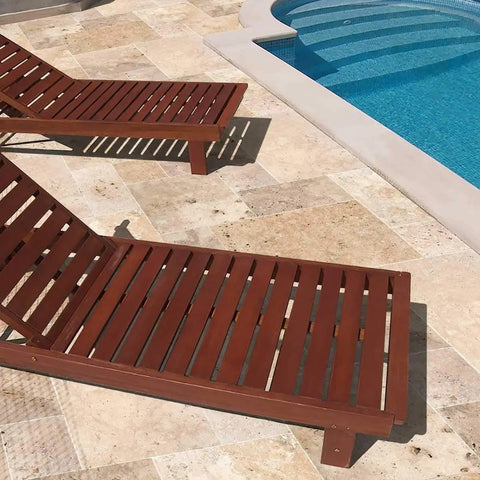
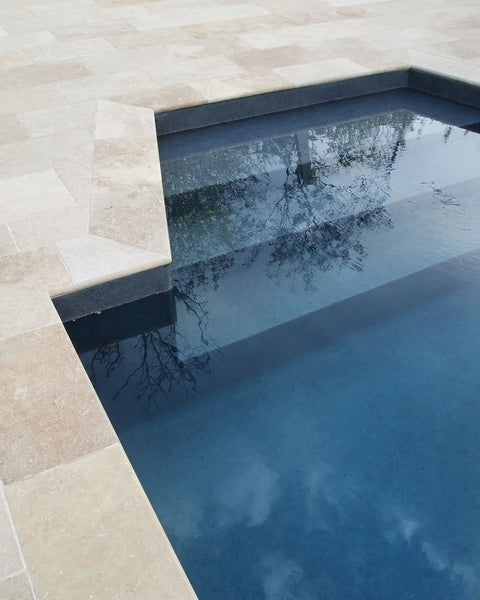
Travertine is the iconic choice, along with light and golden limestones. Their cream, sand, and honey tones capture the light and naturally extend the architecture of Southern regions.
Warm, never cold, these stones are equally at home in an old farmhouse, a contemporary villa, or a holiday home.

COUNTRY HOUSE
Floors that look like they've always been there
The safest choice remains limestone. France is a country with large limestone regions: from Burgundy to Provence, its architecture, its villages, and much of its ancient flooring have been shaped from this stone.
Available in a multitude of shades, from creamy white to golden beiges to grays, it is naturally the first choice for recreating the spirit of an old house.
Checkers, cabochons, multi-formats, or random lengths: these compositions extend this history. The aged finishes, worn edges, and more generous joints give the floor that weathered and lived-in character, as if it had always belonged to the house.

mountain
Wood, stone and chalet spirit
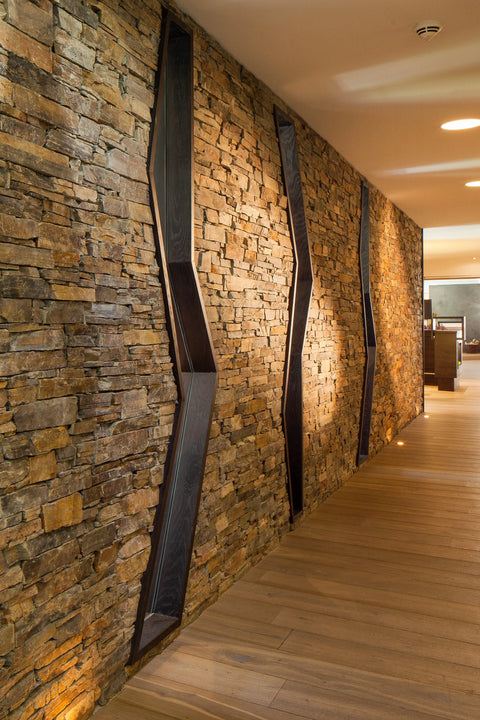
Gneiss, quartzites, slates, and granites are the natural choices in this world. Their textures, nuances, and raw character echo mountain landscapes and naturally find their place alongside solid wood, large fireplaces, and thick materials.
Strong stones, equally at home in an old chalet as in very contemporary alpine architecture.

NATURE
Authenticity and natural materials
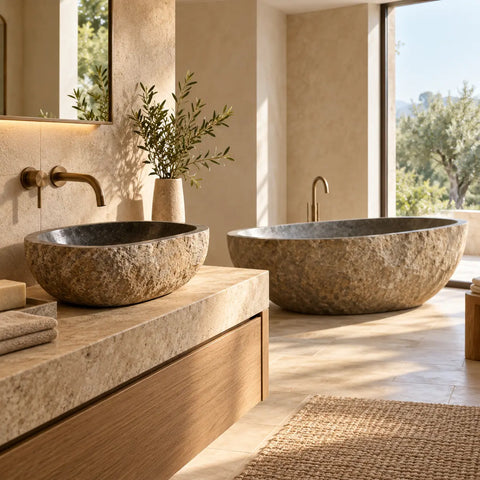
Here, we choose stones that do not seek to be perfectly uniform. Shades, veining, textures, and irregularities are part of the decor and naturally interact with wood, lime, and linen.
Flooring with an organic character, for soft, raw, and unadorned interiors.
2. WHICH COLOR SHOULD I CHOOSE?

BEIGE

WHITE

GREY

MULTI-TONE
3. WHICH FORMAT TO CHOOSE?
The real question: highlighting the space or drawing attention to the floor?

SQUARE
2 formats, 2 radically different effects
In large format, such as 80 × 80 cm, the square is the contemporary choice par excellence: large surfaces, straight edges and perfectly clean lines.
In small format, such as 20 × 20 or 30 × 30 cm, the effect is reversed. The repetition of the tiles creates rhythm and multiplies the natural nuances of the stone, for a much livelier floor.

Rectangular
The most common format, whose look depends on the installation
When laid in straight lines, the slabs create a regular and very contemporary floor.
Staggered or with one-third and two-thirds offsets, they break up this linearity and give the floor more rhythm, allowing more room for the natural nuances of the stone.

Free length
The common sense of the old limestone regions
Also known as abbey formats, random lengths originated in large limestone regions of France, such as Burgundy. The principle was simple: do not waste stone. A 130 cm slice yielded two slabs of approximately 65 cm, rather than two 60 cm slabs and a useless offcut.
The width remains fixed, but the lengths generally vary from 50 to 90 cm. The result: no tile effect, the joints are staggered and the floor never repeats itself. A legacy of ancient French flooring that, depending on the chosen stone, works just as well in a contemporary architectural setting.

Opus IV: Multi-format
A floor composed like a puzzle
Its name already tells its story. The Roman Opus (or Opus IV) revives an ancient principle: composing the floor with stones of different sizes rather than cutting them all to the same format. Large and small slabs are thus assembled in a single unit, making use of each piece of stone.
Today, Opus 4 perpetuates this spirit with four square and rectangular formats that fit together like a puzzle. The joints change direction, repetition disappears, and the floor takes on that irregular rhythm so characteristic of ancient paving.

Checkerboard
One design: 2 stories
The checkerboard pattern is based on a very simple idea: alternating two stones of different colors. But depending on the materials and finishes, the result changes completely.
In limestone, with natural nuances, aged edges, and more prominent joints, it recaptures the spirit of ancient French floors. This is the checkerboard for character homes, often reserved for entrances and kitchens, then paired in larger rooms with free-length paving using one of its two stones.
In marble (often black and white), with straight edges and fine joints, the same design completely changes register. More graphic, more Parisian, it is a timeless classic that regains all its nobility in natural stone — far from the sometimes old-fashioned image of checkered tiles.

Cabochon
The detail of the mansions
A cabochon is a small contrasting stone square inserted between large slabs. Very common in the entrances and hallways of French mansions, it allowed to break up large surfaces without going as far as the strong contrast of a checkerboard pattern.
Made of limestone, with a well-proportioned cabochon, it remains one of the great classics of French heritage flooring: more discreet than a checkerboard, but with much more character than a plain paving.
4. WHICH FINISH / TEXTURE TO CHOOSE?

AGED

SANDBLASTED BRUSHED

HONED

CLEAVED / NATURAL

TOOLED
5. WHICH STONE SHOULD YOU CHOOSE FOR YOUR FLOOR?
LIMESTONE

TRAVERTINE

BLUESTONE

MARBLE

QUARTZITE

GNEISS

GRANITE

SLATE
Discover our BEST-SELLERS
-
 Web priceMineral SelectionFloor & Wall / Indoor & Outdoor
TRAVERTINE RUSTIC Flooring
Regular price From 16,90€ /sqmFrom 16,90€ /sqm Sale price -
 Web priceFloor & Wall / Indoor
DUNE IVORY Limestone Paving, Tumbled
Regular price From 34,90€ /sqmFrom 34,90€ /sqm Sale price -
 Web priceFloor & Wall / Indoor & Outdoor
LIMA BEIGE Flooring, Rough Edges
Regular price From 29,50€ /sqmFrom 29,50€ /sqm Sale price -
Floor / Indoor
CARRARA Marble and MARQUINA BLACK Chequerboard Paving
Regular price 109,00€ /sqm109,00€ /sqm Sale price


Answers to your questions about natural stone indoors
Why choose Mineral for your natural stone indoor flooring?
At Minéral, we have been selecting natural stones for many years, renowned for their quality, durability, and aesthetic appeal. Our range includes noble materials such as travertine, limestone, slate, quartzite, and marble, available in various formats, finishes, and shades to suit all interior styles.
Thanks to our direct relationship with quarries and producers, we offer products with the best value for money, with lasting availability of references and advice tailored to each project. Whether you wish to furnish a living room, a kitchen, a bathroom, or a staircase, our teams will assist you in choosing the most suitable stone, finishes, and formats.
By choosing Minéral, you benefit from a wide selection of natural stones, personalized support, and recognized expertise to bring an elegant, authentic, and durable interior project to life.
How to maintain an indoor natural stone floor?
A natural stone floor is easy to maintain provided you use products suited to its nature. Regular cleaning and appropriate protection will preserve its appearance, nuances, and daily resistance for a long time. To discover best practices, recommended products, and our advice for each type of stone, consult our indoor natural stone maintenance guide.


